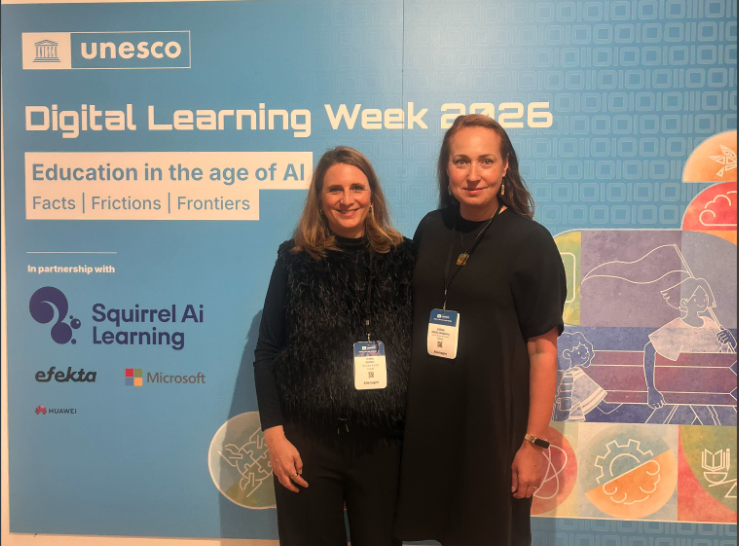
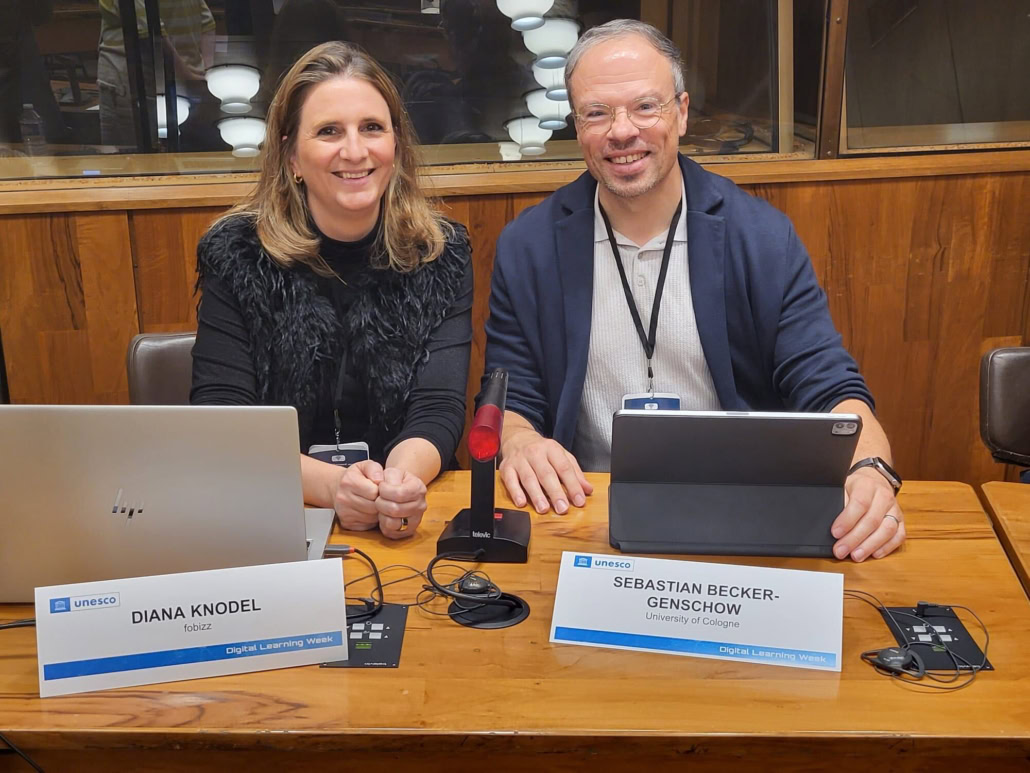
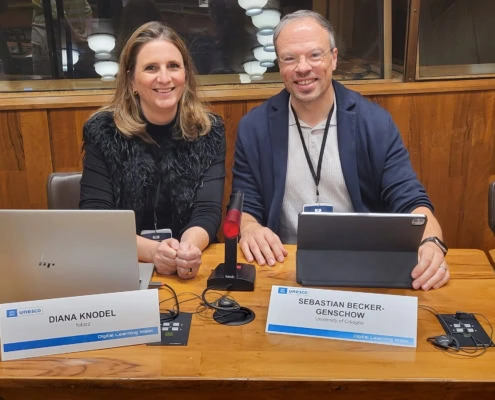
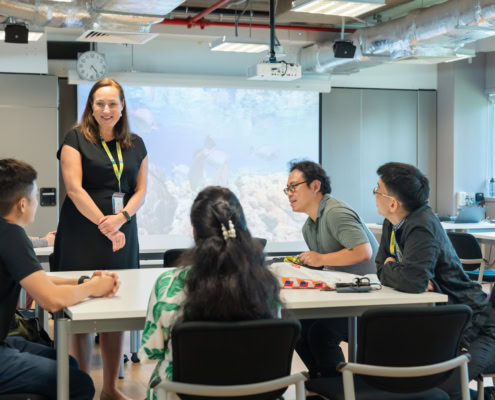
That was the focus of a panel titled “Building and expanding teachers’ agency” at UNESCO’s Digital Learning Week, held from 8th to 11th of September 2026 in Paris. Among the speakers were Dr. Diana Knodel, founder and CEO of the German EdTech platform fobizz, and Prof. Dr. Sebastian Becker-Genschow of the University of Cologne, alongside colleagues from Spain, Côte d’Ivoire, France, China, and Italy. In their talk, “AI in education: Advancing through the friction,” Diana and Sebastian presented recent research findings on teachers’ AI literacy and brought practical, classroom-level experience into an international conversation about AI in education.
At the center of it all was a question fobizz has been thinking about for a long time: how can we help teachers stay capable of acting with confidence in a world increasingly shaped by AI?
AI Literacy Doesn’t Mean Knowing Every New Tool
ChatGPT, image generators, AI assistants, and a constant stream of new models: anyone trying to stay current with every technological development quickly discovers how difficult that is. For teachers, that can’t mean having to know and master every new AI tool. What matters far more is a solid foundation of AI literacy; understanding how AI works, being able to assess its capabilities and limitations, critically questioning its outputs, and making a conscious decision about when using it makes pedagogical sense, and when it doesn’t.
However, knowledge alone isn’t enough. That was the core message Diana Knodel and Sebastian Becker-Genschow brought to Paris: the biggest lever isn’t knowledge but self-efficacy. When teachers feel confident, and have the tools and infrastructure they need, they draw on their own pedagogical expertise and build supportive and useful outcomes: from art-history chatbots for primary school to accounting bots for vocational schools.
Because even someone who knows a great deal about AI in theory doesn’t necessarily feel confident actually using it in the classroom. What helps? Trying things out. Gaining experience. Developing your own ideas. And having a framework in which uncertainty and critical questions have a place too.