AI Is Forcing Us to Get Clearer About What We’re Actually Teaching
This has real implications for how schools design assignments.
If AI can summarize a text in seconds, the key question is not whether summaries are still worth assigning. The key question is what the assignment was meant to teach in the first place.
If the goal is simply to produce a good summary quickly, AI can be a genuinely useful tool. If the goal is to help students identify what matters, weigh information, and express ideas in their own words, then a ready-made AI summary bypasses the learning the task was designed to encourage.
The same logic applies to presentations, arguments, research tasks, coding assignments, and more. Whether AI use makes sense is not a property of the task itself. It depends on the learning goal behind it.
That points to a question teachers will increasingly need to ask: What kind of thinking do I want this task to build, and how much of that thinking am I willing to hand over to AI?
Designing tasks around that question takes practice. Our course, Designing AI Fluency Missions by Phil Alcock, offers hands-on guidance for building assignments that use AI deliberately and with learning in mind.
The Future Isn’t “AI or No AI”
None of this is an argument for keeping generative AI out of the classroom. AI is already deeply woven into how students live and learn, so a complete ban is unlikely to be realistic.
There will still be times when working without AI is the right choice. Foundations need to be built, skills need practice, and knowledge needs to be accessible without a digital tool.
Students also need meaningful opportunities to learn with AI. They need to see how it can explain concepts, provide feedback, ask useful questions, and support practice. They also need to scrutinize its answers and understand its limitations. Access to a chatbot is not the same as AI literacy.
Building that judgment, knowing when AI is helping students think and when it is beginning to think for them, is the focus of our course, AI Efficiency vs. AI Dependency: Protecting the Thinking in Student Work by Rachelle.
Tool or Shortcut? A Judgment We All Need to Learn
Research on the long-term effects of generative AI on learning is still developing. These studies do not answer every question. They do bring the most important questions into focus: Which skills do students still need to master without AI? When does AI support the learning process, and when does it replace it? How should homework and exams change when AI is always available? How can we design tasks so that AI does more than produce stronger outputs and genuinely contributes to learning?
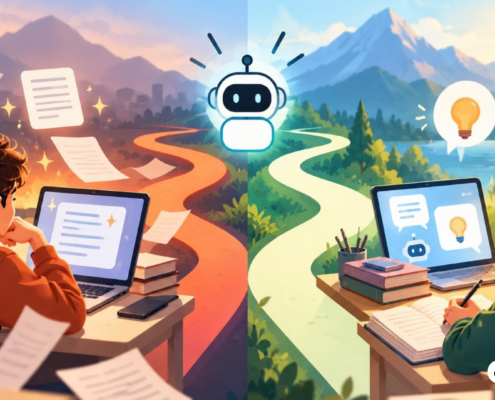
The question is no longer simply, “Should students use AI?” It is this: When is AI a tool that helps students learn better, and when does it become a shortcut that skips the part they were supposed to learn?
No AI can make that judgment for us. That may be the AI skill most worth teaching students today.